Skip to content
All game projects
In development Hospital Management Simulation Unity

MedicaLife

A hospital-management simulation combining hospital operations, patient flow, diagnosis and treatment with progression and finance systems.

MedicaLife project overview

Overview

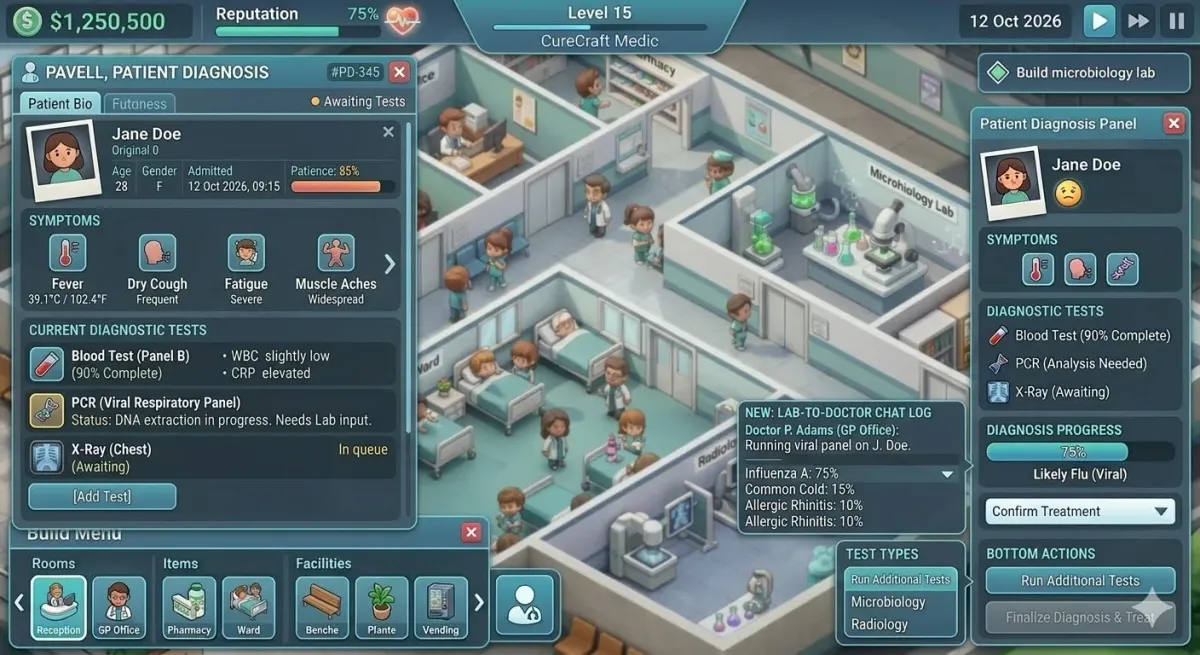
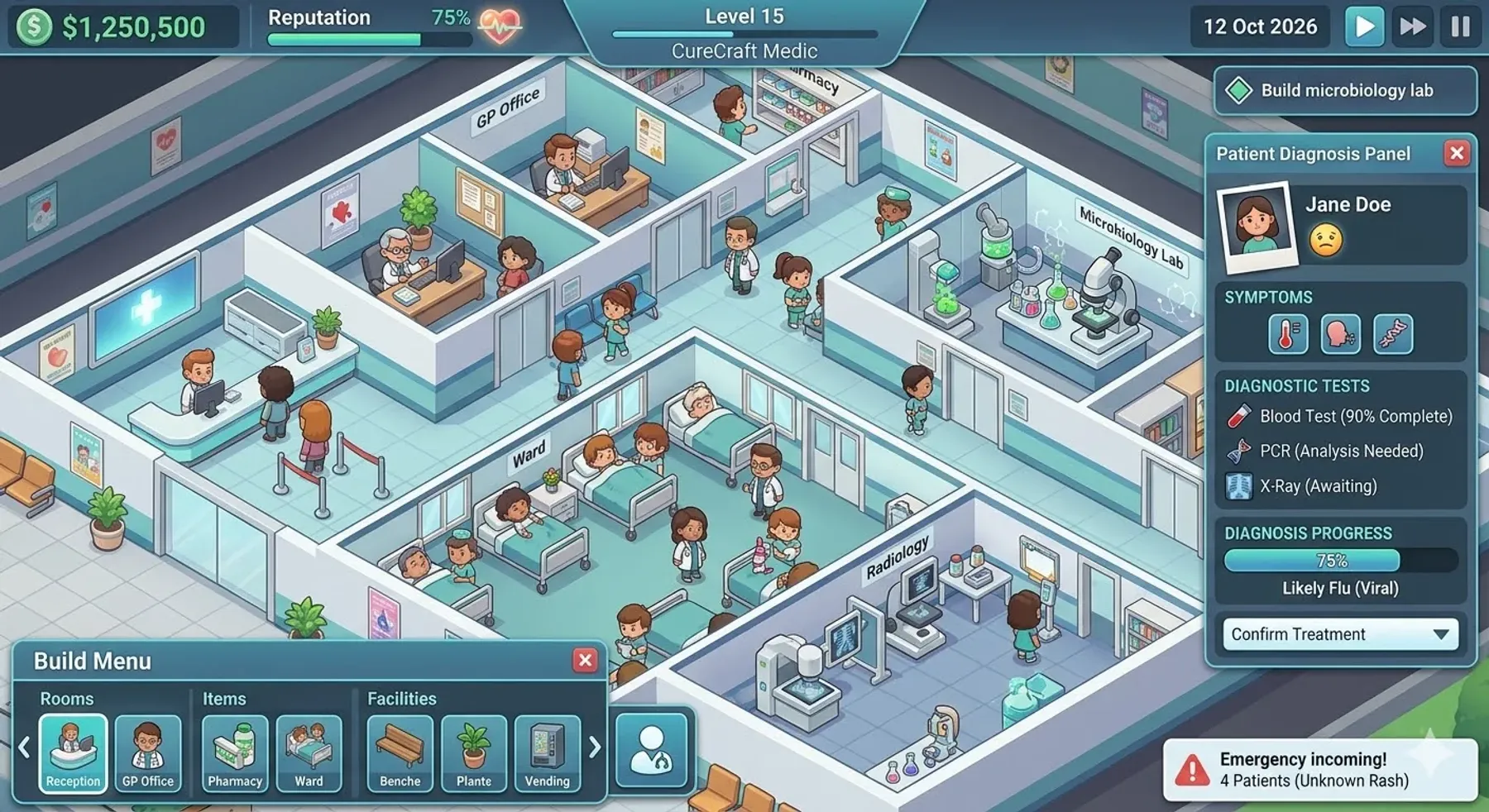
MedicaLife explores how a detailed hospital simulation can remain immediately readable. Rooms, staff and patient behaviour form the visible layer, while diagnosis, treatment, reputation, equipment and finance create the management loop underneath.

Development areas

  • ▹Hospital construction
  • ▹Patient and staff flow
  • ▹Diagnosis and treatment
  • ▹Management UI and progression

Prototype showcase

See the project in motion

Video demo

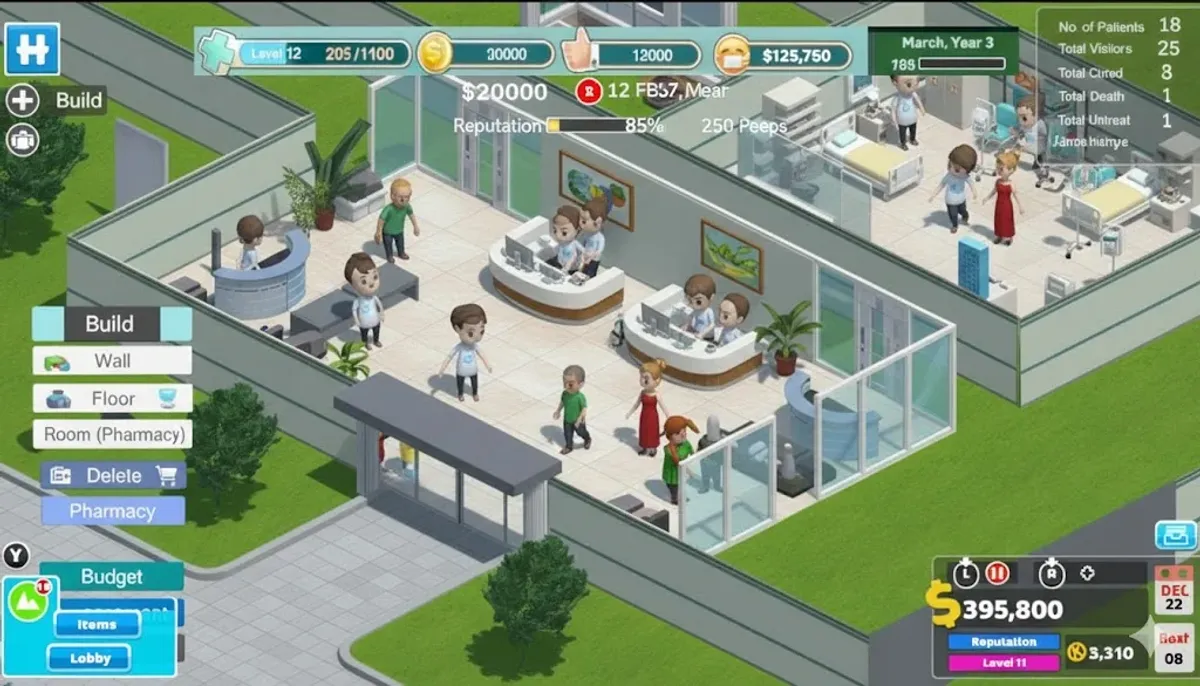
An early Hospital Tycoon prototype showing the foundations of the hospital-management simulation that became MedicaLife.

Design note

What classic hospital games get right

Classic hospital-management games stay readable because rooms, queues and patient needs are legible at a glance. MedicaLife keeps that clarity while exploring more modern diagnosis, progression and simulation systems underneath.

Architecture

The patient loop

Every patient walks the same pipeline; the hospital the player builds decides how fast and how safely they get through it.

  1. 01

    Arrival

    Patients spawn with a condition from the disease data

  2. 02

    Reception

    Check-in and routing

  3. 03

    Diagnosis

    GP, X-ray, diagnostics or psychiatry

  4. 04

    Treatment

    Room and staff matched to the diagnosis

  5. 05

    Outcome

    Cured, or lost to queues, walking or incidents

  6. 06

    Reputation & cash

    Feeds back into who arrives next

Pressures on every step

Staff availability (receptionist, doctor, nurse, janitor, security)Room capacity and layout distanceQueue lengthCleanliness and infectionIncidentsDisease and treatment data

Simulation & balancing

Testing the economy with automated agents

MedicaLife runs scripted AI players through the same scenario dozens of times, each with a different strategy, and reports survival, cash, reputation and win rate, so balancing problems show up before manual playtesting.

  1. 01

    Simulate

    7 strategy agents × 50 runs each

  2. 02

    Measure

    Win rate, survival days, cash, reputation, failure causes

  3. 03

    Audit

    Win rate 30–70%, ≥ 3 strategies, no dominant strategy, balance-quality score ≥ 70

  4. 04

    Adjust

    Rules, prices and the value of rooms and staff

Re-run the same suite after every change

Evidence

A real balance report

Output of one automated run (7 agents × 50 runs, “current” preset, 6 June 2026). Each agent plays a fixed strategy; the verdict compares its win rate with the target band.

Strategy agentWin rateAvg days survivedAvg cashAvg reputationMost common failureVerdict
Premium (high fees)66%29.825,7636.7Queue collapseHealthy
Reactive queue46%29.74,54536.8Queue collapseHealthy
Budget volume28%28.9−24329.9Queue collapseToo hard
Balanced16%29.3−1,30117.7Layout collapseToo hard
Reputation-first10%27.7−6,17818.9Layout collapseToo hard
Greedy money2%20.5−4,0480.2Layout collapseToo hard
Do nothing (baseline)0%19.115,9660Missing departmentsToo hard

The do-nothing baseline never wins, so the player has to act, while two different strategies reach a healthy win rate.

What testing changed
CheckEarlier runLater run
Viable winning strategies12 (6 archetypes seen)
Share of the top strategy100%39%
Recovery after a setback24 / 10066 / 100
Balance quality score (automated heuristic)57 / 10087 / 100
Balance auditFailPass

Two runs of the suite an hour apart on the same day: the earlier run failed the audit with a single dominant strategy; the later run, after changes and two additional strategy agents, passed all four checks. All figures come from scripted agents, not human players — the balance-quality score is an internal heuristic calculated by the test suite, not a measure of player enjoyment. Human playtesting comes next.

What I built

  • Designed the hospital building and room placement flow
  • Modelled patient states from arrival through diagnosis and treatment
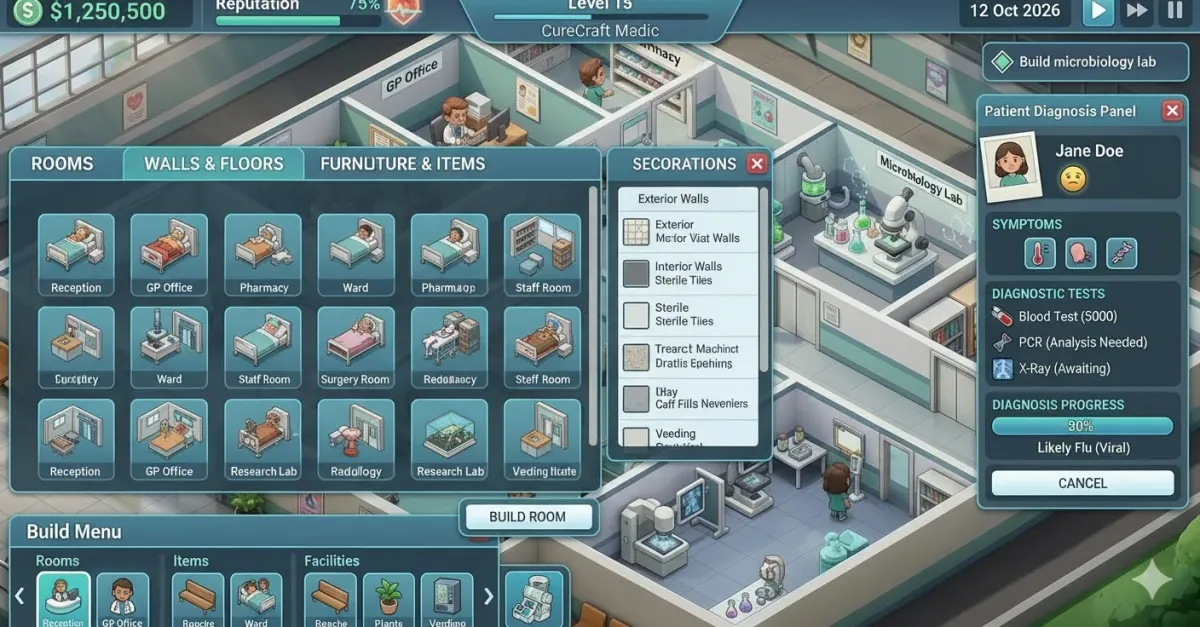
  • Prototyped management UI for staffing, equipment and finance
  • Established a data-driven structure for adding diseases and treatments
Key challenges

  • Showing several simulation states without overwhelming the player
  • Keeping patient queues, room capacity and staff schedules predictable
  • Making management decisions readable at both room and hospital scale

Next steps

  • Stress-test patient flow with larger hospitals
  • Add staff specialisations and progression
  • Create onboarding scenarios for the core management loop

Project gallery

MedicaLife development image 2MedicaLife development image 3MedicaLife development image 4

Interested in games, interactive technology or indie development?

Get in touch